
Road tax
Can a motorhome really pay £1 road tax?
Why some owners are being quoted £1 HGV tax, who can actually use the rate and why private motorhomes usually cannot.
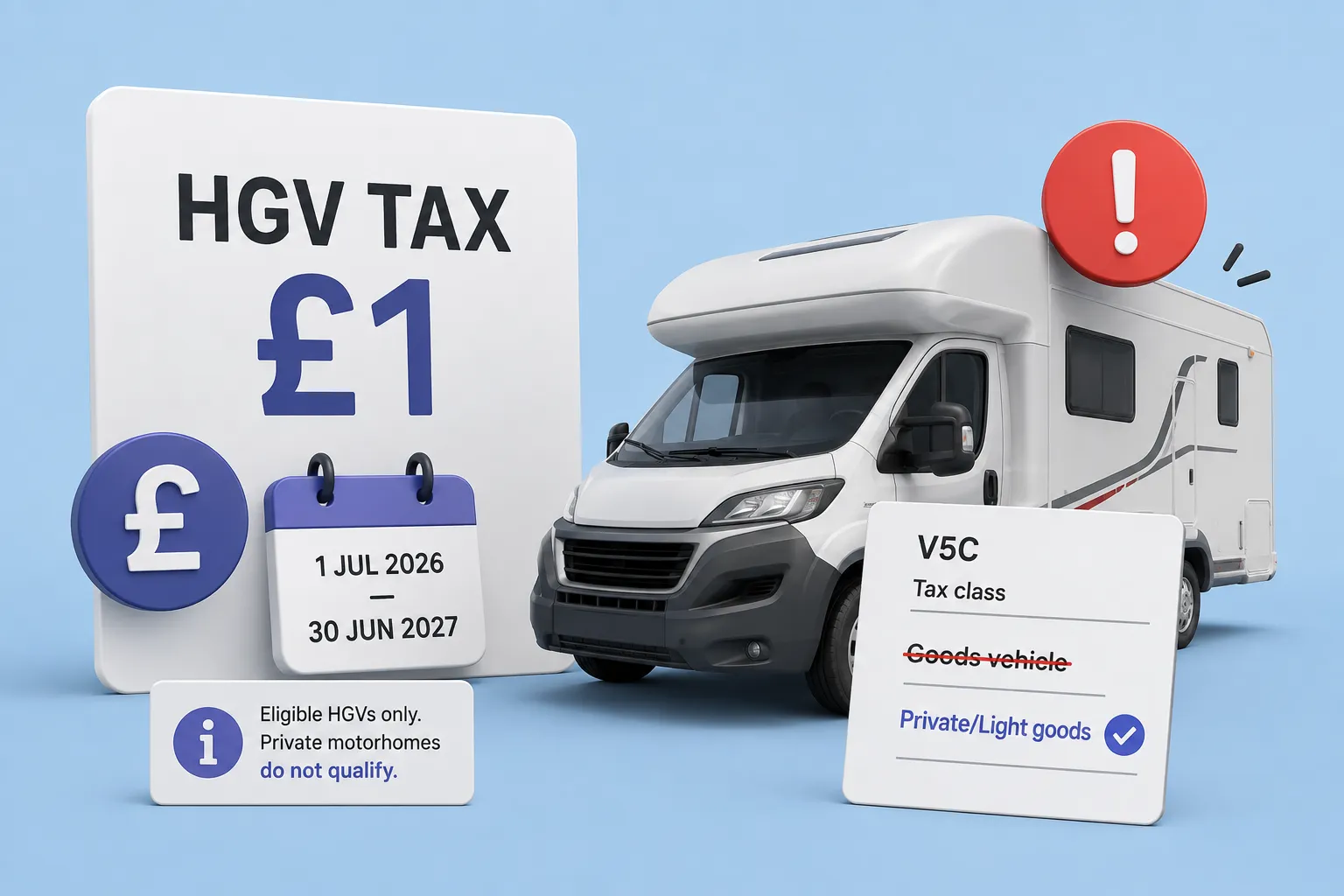
This is general information about published vehicle tax rules. It is not personal tax, insurance or legal advice. Always check the tax class on your V5C and the current tables on GOV.UK before you pay.
What motorhomes should normally pay in 2026/27
GOV.UK publishes motorhome rates based on revenue weight (also called maximum or gross vehicle weight) and tax class. The figures below are the single 12 month payments shown on the motorhome rate tables for the 2026/27 year.
Private or light goods (TC11)
Use this class when revenue weight is 3,500kg or less. Annual vehicle tax is £230 if the engine is not over 1,549cc, and £375 if it is over 1,549cc.
Private heavy goods (TC10)
Use this class when revenue weight is over 3,500kg and the vehicle is taxed as a private heavy goods vehicle. The published single 12 month payment is £177.
| Factor | Private TC11 | Private TC10 | Temporary £1 HGV |
|---|---|---|---|
| Who | Revenue weight 3,500kg or less | Over 3,500kg, private heavy goods | Classes 1, 2, 16, 23, 57 |
| 12-month rate | £230 or £375 by engine size | £177 | £1 VED in the window |
| Private motorhome? | Usual class | Usual class if over 3,500kg | No |
Single 12 month payments from GOV.UK motorhome tables for 2026/27. Eligible HGVs may still pay the HGV levy. Recheck GOV.UK when you tax the vehicle.
Some motorhomes first registered between 1 April 2017 and 11 March 2020 pay a different rate if they are in the M1SP category and CO2 is on the type approval certificate. If that applies, use the GOV.UK motorhome tables rather than assuming TC10 or TC11.
You can confirm current tax status for a specific registration with the tax and SORN tool on Caroat, then still read the class on the V5C. Status and class are related, but the class is what decides which tariff applies. For a quick annual-bill lookup on a plate, MOTCO’s tax calculator uses the same kind of DVLA record.
Weight and tax-class differences
Revenue weight is the key split at 3,500kg. Below that, a private motorhome is usually TC11. Above that, it is usually TC10. Commercial goods HGVs sit in different classes again, with rates that vary by weight, axles and use.
Body type on the V5C (for example motor caravan) is not the same thing as tax class. A converted van can look like a motorhome and still be recorded in a goods class if that class was never changed.
What the temporary £1 HGV rate actually is
From 1 July 2026, DVLA guidance says most HGVs in listed tax classes qualify for a temporary reduced vehicle tax rate of £1 for 12 months. If the vehicle is eligible, the reduced rate is applied when you tax it during the window.
This reduces vehicle excise duty (VED) for those classes. If the vehicle also has to pay the HGV levy, GOV.UK says the levy is still charged at the current rate alongside the £1 VED. That is another reason the headline £1 figure is not a simple “road tax is a pound” story, even for true HGVs.
Period: 1 July 2026 to 30 June 2027
The £1 rate applies to eligible vehicles taxed between 1 July 2026 and 30 June 2027. If the vehicle was taxed before 1 July 2026, GOV.UK says you pay the rate that applied then and you do not get a refund. You can use the £1 rate the next time you tax it during the reduced-rate period, if the vehicle is eligible.
The rate on a paper reminder may still show the old figure. DVLA says the correct rate is applied when you tax the vehicle.
Which eligible HGV tax classes can use it
DVLA lists these tax classes for the temporary £1 rate:
- 1 (HGV)
- 2 (Trailer HGV)
- 16 (Small Island)
- 23 (Combined Transport)
- 57 (Special Types)
You find the class on the V5C. Private light goods (TC11) and private heavy goods (TC10) are not on that list.
Why DVLA may sometimes quote a motorhome £1
If the record still says the vehicle is in an eligible goods HGV class, the system can offer the temporary £1 rate even when the vehicle is used as a private motorhome. That quote is a data issue, not proof that private motorhomes were included in the policy. Check the class printed on the V5C before you pay.
Wrong goods-vehicle tax class remaining on the V5C
This often starts with a van, a chassis cab or another goods vehicle that was later converted. The body may now be used as a motorhome, while the tax class was never moved to TC10 or TC11.
GOV.UK is clear that you do not change tax class by editing the V5C as if it were a simple spelling correction. You change class through the vehicle tax process, and in some cases you must apply by post, for example after a change of use or body type.
Leaving a commercial goods class on a vehicle that is not used that way can also affect how insurers and testers see the vehicle. Get the record aligned with how the vehicle is actually used.
Risks of knowingly paying the wrong £1 rate
Do not treat this article as a ruling on your case. If the class looks wrong, stop and sort it with DVLA before you rely on a £1 quote.
How to correct the tax class with DVLA
Start with the official guide: Change your vehicle’s tax class. How you apply depends on whether tax is about to run out, and on whether you have changed use or body type.
- Have the V5C in the keeper’s name
- Take any tax reminder if you have one
- Take MOT evidence if the vehicle needs an MOT
- Be ready to pay the correct rate for the new class
Some changes can be done at a Post Office that handles vehicle tax. Others must go by post. DVLA then sends an updated V5C. If a refund is due after a valid class change, DVLA handles that as part of the tax process.
Use Caroat’s free check to see current tax status on the registration, then compare it with the class printed on the log book. If they tell different stories, believe the V5C and GOV.UK until DVLA has updated the record.
Official GOV.UK sources
- Temporary £1 vehicle tax for most heavy goods vehicles
- Temporary Vehicle Excise Duty rates for heavy goods vehicles
- Vehicle tax rates: motorhomes
- Change your vehicle’s tax class
- Check if a vehicle is taxed
Rates and eligibility can change. Recheck those pages when you tax the vehicle, including after 30 June 2027 when the temporary HGV reduction is due to end.
FAQ
Can a private motorhome use the temporary £1 HGV tax rate?
No. The temporary £1 rate is for listed goods-vehicle tax classes only. A private motorhome should normally be in private light goods (TC11) or private heavy goods (TC10), which are not on that list.
When does the temporary £1 HGV rate apply?
Eligible vehicles taxed between 1 July 2026 and 30 June 2027 can get the reduced £1 vehicle tax rate. Taxing before 1 July 2026 does not get a refund of the earlier rate.
Which tax classes can use the £1 rate?
GOV.UK lists tax classes 1 (HGV), 2 (Trailer HGV), 16 (Small Island), 23 (Combined Transport) and 57 (Special Types).
Why did DVLA quote my motorhome £1?
The quote follows the tax class on the vehicle record. If that record still shows an eligible goods HGV class, the system may offer £1 even though a private motorhome should not be in that class.
What should a typical private motorhome pay in 2026/27?
GOV.UK motorhome tables for 2026/27 show TC11 (3,500kg or less) at £230 or £375 a year depending on engine size, and TC10 (over 3,500kg) at £177 a year for a single 12 month payment. Some motorhomes registered between 1 April 2017 and 11 March 2020 can pay a different CO2-based rate.